All Generations Will Call Me Blessed: A Brief Biblical Mariology
“For he has looked on the humble estate of his servant. For behold, from now on all generations will call me blessed;” Luke 1:48 ESV

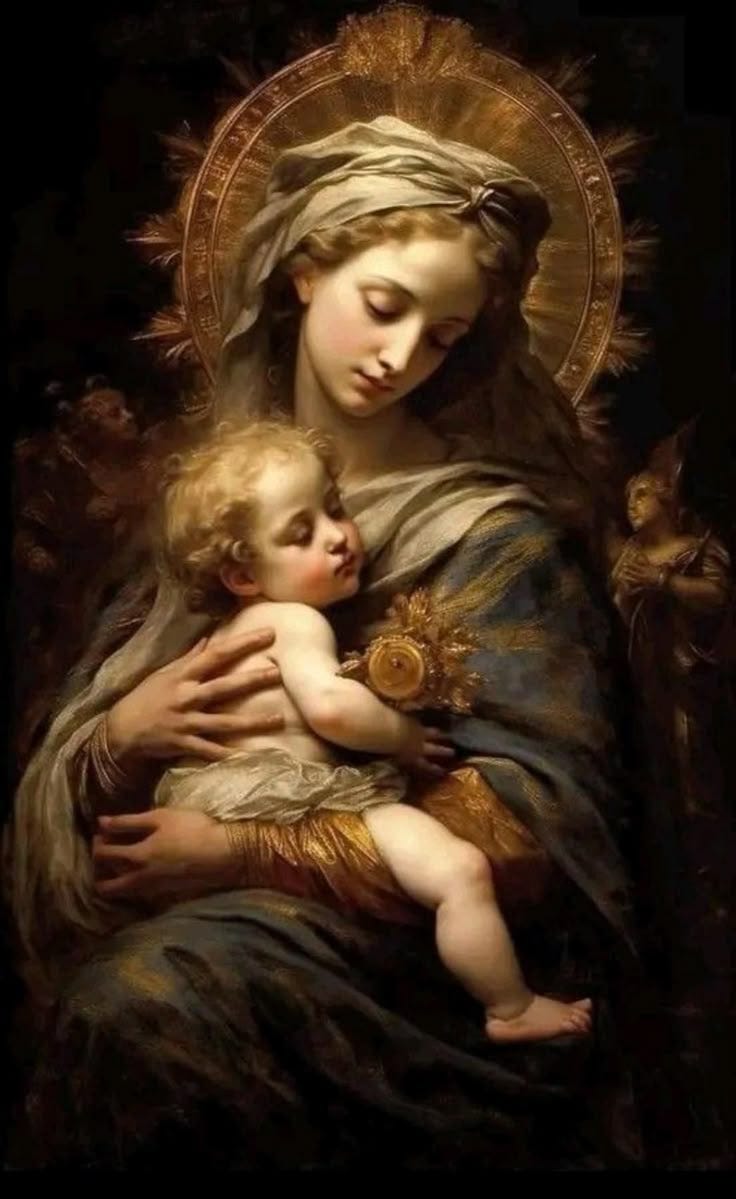
In Protestant circles the blessed virgin Mary is often not spoken about very much in the gospel message–if at all. In Restorationist Christianity, we fall prey to the same error. I have even heard some say that there was “nothing special about Mary” or that “she doesn’t matter.” Most won’t say it this strongly, but this is an implicit sentiment in many circles, especially in the Church of Christ. I also get why Restorationist Christians and Protestants more broadly would sometimes minimize Mary. It comes from a heart wanting to elevate Christ, and it is true to say that in the past bad Mariology has led to lessening Christ. We all have heard about the abuses and errors of the middle ages or have seen the misunderstandings that Catholic and Orthodox laymen can sometimes have even today. However, we must fight to not create an anti-identity. We must build a positive theology, not just a polemical one. In our effort to not be like others groups with certain errors around Mary, we must not throw out their Biblical beliefs along with the errors and accretions. We are a church trying to follow the Bible, not a church just trying to be different from all the others so that we don’t appear “denominational.”
The beautiful and awesome thing about Mariology is that, when it is done well, it points to Jesus. Elevating the blessed virgin Mary and her role in the gospel story leads us to a greater appreciation of Jesus and His greatness as it seeps into and sanctifies all those around Him. Mary is blessed because she is Jesus’ mother and she is blessed because she followed God’s plan for her, which includes her being His mom. The blessed virgin is the Theotokos, the first Christian, the model of the church, God’s temple, the Davidic queen, and the new Eve through her virginal conception.
Theotokos
This is the Greek term for the title God-Bearer or Mother of God. At first, those who don’t know much about the history of the term may be freaked out. “You think Mary is the mother of the Divine Nature? Doesn’t that put her above God?” If this is what the term means, then it should be denounced as heretical and removed from our theological language. That, however, is not the history of the term.
The term has always been related to Christolological debates–namely the nature of and relation of Christ’s divinity and His humanity. It was first challenged by Nestorius in 431 AD at the Council of Ephesus. Nestorius opposed the use of the term because he is portrayed as having believed that Jesus is two persons (ὑπόστασις)–one divine, one human. Nestorianism believes that Mary only gave birth to the human person (ὑπόστασις) of Jesus. Nestorius’ error was dividing Jesus and the Logos into two persons/modes of being, thus separating man and God, effectively making Christ’s incarnation unnecessary for salvation. As St. Athanasios says, “God became man so that man might become god.” Or consider Hebrews 2:17 (ESV): “Therefore he had to be made like his brothers in every respect, so that he might become a merciful and faithful high priest in the service of God, to make propitiation for the sins of the people.” The orthodox view is that He is one person/mode of being (ὑπόστασις) in two natures–one human, one divine. It is necessary that Jesus is one united mode of being or person. If He were not, then Hebrews 2:17 could not be true. The story of salvation would also be compromised. It is necessary that He is by nature man, so that He can atone for us as our substitute, and also necessary that He is by nature God so that we can be glorified with Him and so that He can conquer death, which has no power over God. Thus, Jesus is one person with two natures. These natures, being united in one mode of being/person, are united together like a ball of clay and iron–totally inseparable and yet totally distinct. This is the Hypostatic Union. Since Jesus is one person, then all titles that apply to His two natures make up the titles that can be ascribed to His one person/mode of being. Therefore, we can say that Mary is the Mother of God or the Theotokos.
That was a long aside of deep history and theology, but it was necessary to get across what exactly is meant by Theotokos and why exactly Christians must affirm it. As you can see, Mariology is often just a branch of Christology. The two are intimately connected because Mary points to Christ. Every biblical role she has and biblical title ascribed to her says something about her son.
First Christian
Mary, in many ways, is the first Christian. She was the first person to, on the basis of faith, accept Jesus. Mary received this gift by God’s grace and not by her own merit. She was just a lowly servant, elected by God according to His will. Unlike Zechariah, she didn’t argue or doubt. She just trusted in God’s promises and remained faithful even when things were hard such as the suspicion of her community or her flight to Egypt. Almost all of her few words in the gospels are praises to God. What an amazing example of faith and Christian living! We ought to emulate her.
Type of the Church
All throughout the prophets God speaks of Israel as an unfaithful and impure woman. In Mary, we find the opposite–a pure and trusting woman of God. Unlike God’s covenant people Israel, she is faithful. This images the church that was to come in the gospel narrative, where God finds a faithful and pure woman and is able to dwell there. Mary is the New Covenant type and model of the church.
She was the dwelling place of God, just as the church is now. She was the means through which Christ entered the world, just as the church is the means through which Christ interacts with the world now–namely through the sacraments, the ministry of benevolence, and the Word. She was the gate to Christ, just as the church is the gate to Christ.
Davidic Queen
“Now a great sign appeared in heaven: a woman clothed with the sun, with the moon under her feet, and on her head a garland of twelve stars. Then being with child, she cried out in labor and in pain to give birth.” (Rev. 12:2 NKJV). Mary is here identified as a glorified figure with a crown of stars, which represents Israel, and thus the people of God. Now, I want to be fair here and also offer some nuances to what I am about to say.
I understand this and sympathize with people who may feel uncomfortable with the title “davidic queen” or “queen of Heaven.” I especially understand the latter since Jeremiah 7:18 and 44:17-18 identify a pagan goddess as the queen of heaven. I would argue that the title queen of heaven could be used in a way that is biblical (as I will in this section), but I would personally use the title davidic queen so as to not offend or confuse anyone.
Also, I understand that the book of Revelation is highly allegorical because of its apocalyptic genre. However, this does not make the book hopeless to interpret and derive doctrine from. It would not have been preserved in the canon if we could not glean doctrine from it. Many passages are hard to decode and so we should have grace and understanding, holding things with a loose hand, but we should still attempt to rightly divide the word in this area, even if it is hard or highly allegorical.
All that being said, I believe Mary is the fulfillment of the messianic queen. In ancient Judah the queen of the land was not the wife or one of the wives of the king but rather his mother. Her title was Gebira–rendered best as “Great Lady” or “Queen Mother.” We see this position often in 1&2 Kings and in 1&2 Chronicles, specifically in the southern kingdom. This Gebira would assume the throne with her son and held a high role in the court under her son. It should also be noted that the queen was not seen as the ruler, but just an advisor. Only the king was seen as one with power over the kingdom.
It’s in this context that we read about a woman giving birth to a son who wars with Satan. This woman is wearing a crown of twelve stars, indicating some type of exalted role among the saints. Jesus is identified as the Davidic king in Luke 1:32-33 (NKJV): “He will be great, and will be called the Son of the Highest; and the Lord God will give Him the throne of His father David. And He will reign over the house of Jacob forever, and of His kingdom there will be no end.” I would be interested to hear an interpretation of all this that doesn’t lead to Mary having some exalted role.
God’s Temple
The blessed virgin Mary was also a type of God’s temple. She is the physical location that God consecrated and in which God chose to dwell. She symbolizes Eden in this way too. Her womb was the abundant garden in which God dwelled. What an amazing thing!
A Type of Eve and Mary’s Virginity
Mary is, in a way, the new Eve (or her typological fulfillment) just as Jesus is the new Adam. This is not making Mary equal to Jesus, but rather it is recognizing typological fulfillments and how they point to Christ. Genesis 3:15a (LSB) says: “And I will put enmity between you and the woman, and between your seed and her seed;” The seed of the woman would be at odds with Satan and presumably his demons. This prophesied woman is Mary. From the seed of woman would come this savior. Isn’t it interesting that, even in a patriarchal culture like ancient Israel, this deliverer is said to be of the woman’s seed? Mary fulfills this in the virginal conception.
Mary is also connected to the Eden story as a type of anti-Eve just as Jesus is a type of anti-Adam. In the Genesis story the woman comes from Adam and God’s breath (πνεῦμα, LXX). In the gospel story the new Adam comes from the woman and God’s Spirit (πνεῦμα). This anti-typology indicates Jesus’ mission in the world. That is, to reverse Adam’s curse through His incarnation, ministry, passion, resurrection, and ascension (Romans 5:12-19). Christ is the anti-Adam who, “by the one man’s obedience the many will be made righteous.” (Romans 5:19b ESV) as opposed to Adam who, “ by the one man’s disobedience the many were made sinners.” (Romans 5:19a).
Mary’s role as the New Eve is tied intimately with her virginal conception. She fulfills the Protoevangelion as the completion of the woman from whom the seed would come, and she fulfills a role as the anti-Eve in the virginal conception. Understanding Mary as the New Eve is helpful for understanding the necessity of the virginal conception.
Concluding Thoughts
We have looked at Mary as the mother of God, the first Christian, a type of the church, God’s temple, the Davidic queen, and as the new eve through her virginal conception. Almost all of these probably feel weird for my Protestant and Restorationist brothers and sisters reading this. If this is your first time looking at Mariology it may seem so foreign that it feels like there’s no way it’s true. These feelings are normal. I felt them when I first embarked on the journey through historical and systematic theology, or first engaged with non-Restorationist denominations. You will likely dismiss this at first if you’re a typical Protestant and you will likely think I didn’t go far enough if you’re Catholic or Eastern Orthodox. As I said, this is a brief look at these topics. I encourage everyone on all sides to consider these words and keep studying on their own.
Finally, I want to explain why I didn’t cover certain topics or why I didn’t say what I was against. That is because there is plenty of polemical work in the field of Mariology–too much in fact. My goal was just to build a positive theology of the blessed virgin. I hope I have achieved this and that people will understand that this was my goal. We should all happily unite around the truths of the gospel that we see expressed through Mary so that we can pray with her “My soul magnifies the Lord and my spirit has rejoiced in God my savior.” (Luke 1:46-47, LSB)